Lab Updates

News

2026

7 items
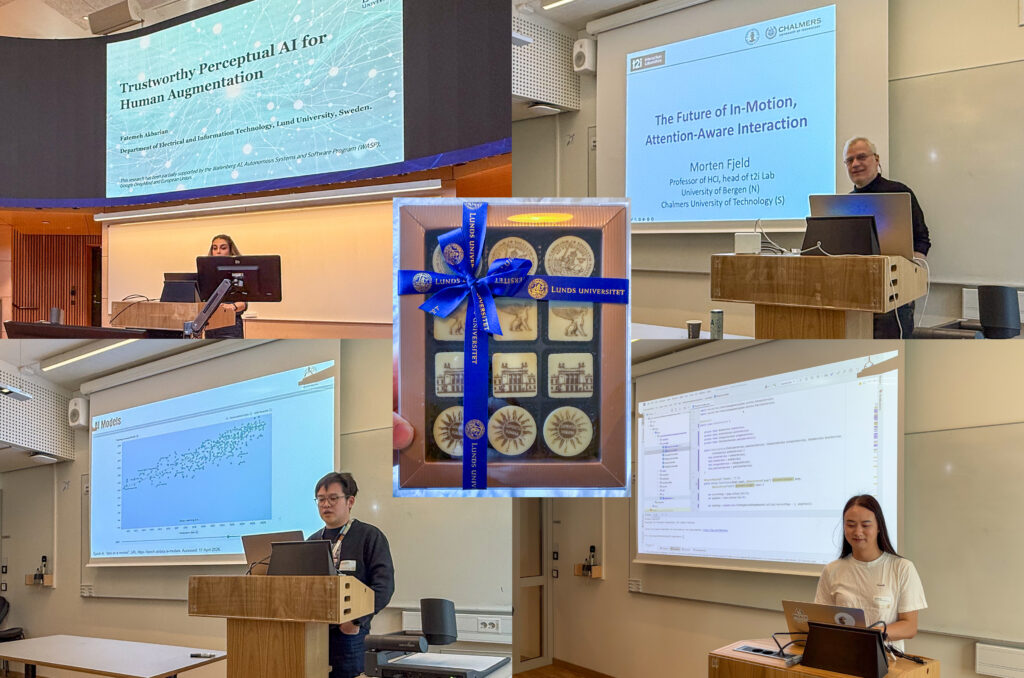
Collage of four presentation photos and one gift photo from the AI Lund fika-to-fika event on perceptual engineering at Lund University. Top left: Dr. Fatemeh Akbarian presenting at a podium, with a slide reading "Trustworthy Perceptual AI for Human Augmentation" from Lund University's Department of Electrical and Information Technology. Top right: Prof. Morten Fjeld presenting at a podium, with a slide reading "The Future of In-Motion, Attention-Aware Interaction," identifying him as Professor of HCI and head of t2i Lab at the University of Bergen and Chalmers University of Technology. Bottom left: Baichuan Huang presenting at a podium, with a slide showing a scatter plot of AI model benchmarks. Bottom right: Peng Kuang presenting at a laptop, with a slide showing code on screen with GazePrinter annotations. Center: a box of Lund University-branded chocolates tied with a blue ribbon, embossed with the Lunds Universitet seal.
A wonderful day at Lund University for the AI Lund fika-to-fika on perceptual engineering. The event featured an invited talk from Prof. Brooks, alongside presentations from Dr. Fatemeh Akbarian on trustworthy perceptual AI, Dr. David Kadish on electronic noses, Prof. Morten Fjeld on attention-aware in-motion interaction, Peng Kuang on GazePrinter and expert gaze visualization, and Baichuan Huang on efficient AI for wearables and multimodal transformers. Many thanks to Professors Emma Söderberg and Amir Aminifar for organizing, and to everyone at AI Lund for a stimulating day.
Read more
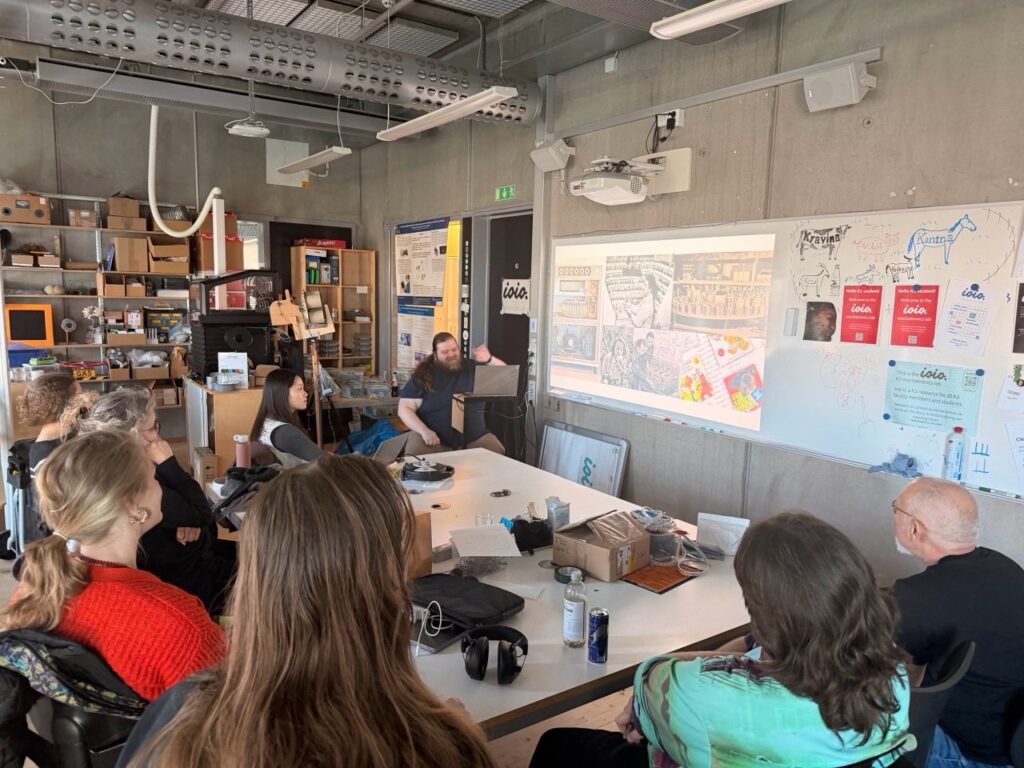
Photo of a small group gathered around a table in a research lab (the Malmö University Scent Club), watching a presentation projected on the wall. The presenter (Professor Brooks), seated at the head of the table with a laptop, gestures toward the projected slide showing illustrated comic-style artwork. Shelves of components, boxes, and equipment line the walls, along with posters and a whiteboard with drawings and "ioio" signage. Attendees are seated informally around the table.
A productive week at Malmö University in collaboration with Professor Simon Niedenthal. The visit included a talk to the K3 Scent Club, as well as the opportunity to hear about ongoing work from the students there and from Prof. Niedenthal, Senior Lecturer Lizette Reitsma, and Dr. David Kadish. Many thanks to everyone for their warm welcome, and to Tarek Alexander Khnijer for the photo.

We are thrilled to congratulate Gene, Alex, Sol, and Yuting on their fellowship awards!

Gene received the National Science Foundation Graduate Research Fellowship, which supports him for several years and recognizes his potential to make significant contributions in STEM. Gene additionally received the MIT Presidential Fellowship, one of the Institute's most prestigious graduate awards.

Alex received the EECS Department's Distinguished Science & Engineering Fellowship, which recognizes outstanding incoming students for their exceptional engineering background and research potential.

Sol received the EECS Department's Vamasundari Devi Fellowship, which supports talented women scientists and engineers at MIT and is awarded in recognition of academic excellence and research promise.

Yuting received the MIT Presidential Fellowship, one of the Institute's most prestigious graduate awards, given to outstanding incoming students and selected by the MIT President and Provost.

Thank you to the Shiv Nadar Foundation, the President and Provost of MIT, the MIT EECS Department, and the National Science Foundation for their support!

We are thrilled to congratulate Dr. Mack Harnett and Dr. Tai Le on their fellowship awards!

Mack received the METEOR Fellowship and will be joining in September as a postdoctoral associate. As a postdoc, Mack will investigate how tactile-focused artists use surface haptic interfaces for creative expression, and how those practices can inform more accessible and expressive tactile media. Mack will receive her PhD in Mechanical Engineering from Texas A&M University, where she was part of the Friesen Haptics Lab led by Prof. Rebecca Friesen.

Tai received the Biswas Fellowship and will be joining in July. As a postdoc, Tai will investigate how nasal interfaces can monitor mucosal health and support new forms of physiological intervention in everyday contexts. Tai received his PhD in Biomedical Engineering from UC Irvine, where he was part of the Hero Lab led by Prof. Hung Cao.

Thank you to the Biswas Family Foundation, the MIT HEALS Collaborative, and the MIT College of Computing for their support!

We're excited to share that we have two co-authored papers appearing at ACM CHI 2026! 🎉

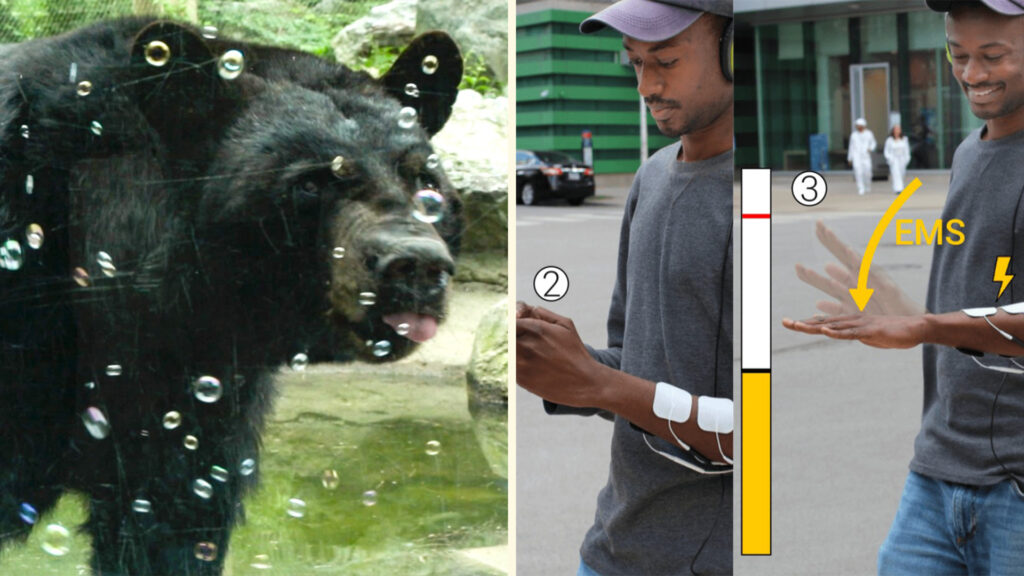
BearBubbles (led by Prof. Rébecca Kleinberger's INTERACT Animal Lab at Northeastern University and Zoo New England) introduces a proximity-activated scented bubble system designed to give zoo animals agency over their own olfactory enrichment. Deployed with two American black bears over three weeks, the system increased foraging and locomotive behaviors and generated rich multi-modal interactions. The work demonstrates how HCI methods can meaningfully support animal welfare and agency in zoo settings.

Increasing Input Accuracy of Embodied Devices via Electrical Muscle Stimulation (led by Prof. Pedro Lopes's Human-Computer Integration Lab at the University of Chicago) tackles a key challenge in embodied interfaces, where the user's body serves as both input and output: keeping proprioceptive input aligned with interface state. The paper presents and evaluates techniques using muscle stimulation to help users recall previous states, confirm transitions, and stay within valid input ranges. Results showed meaningful gains in both input accuracy and user confidence.

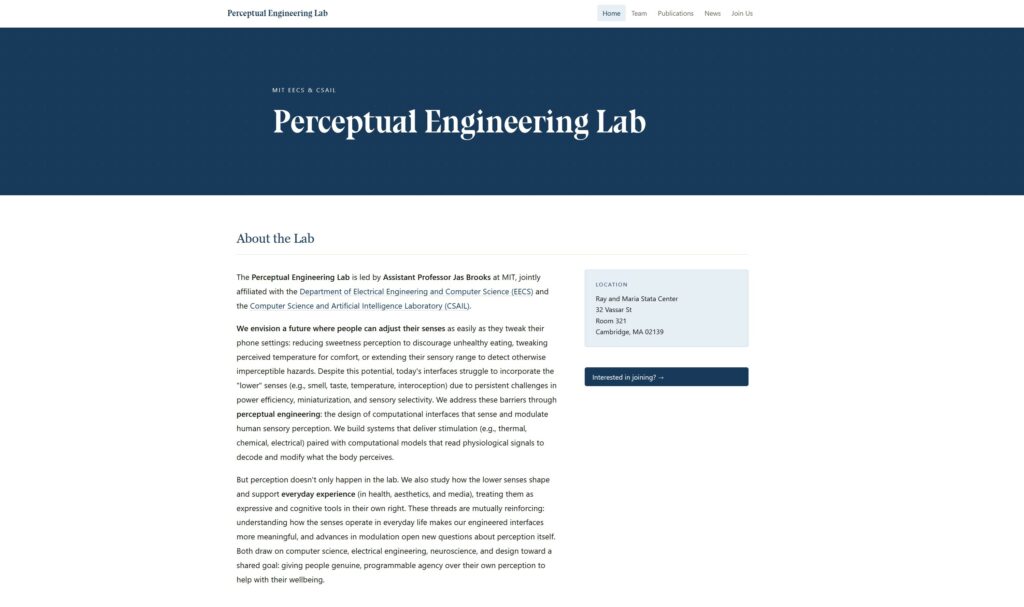
Screenshot of the Perceptual Engineering Lab website homepage, showing a navy header with the lab name and MIT EECS & CSAIL affiliation, followed by an "About the Lab" section describing the lab's research into perceptual engineering.
The Perceptual Engineering Lab website has launched! The lab, based at MIT EECS and CSAIL, investigates how interfaces can precisely target the body's sensory mechanisms to alter perception in controlled, reproducible ways. We look forward to sharing our work here. :)
Prof. Brooks gave an invited talk in Prof. Allen Sayegh's "Responsive Environments" course at the Harvard Graduate School of Design.